If you're running LinkedIn ads for a life science company, there's a good chance your creative looks sharp, your content library is solid, and some leads are coming in.
But there's also a good chance you're paying more per lead than you need to, and converting fewer prospects than your content deserves. In our experience, the gap between what these campaigns could deliver and what they currently deliver often comes down to funnel strategy and platform-specific execution, not the quality of your content or your creative team.
This is a big issue, with life science companies wasting more money than necessary on LinkedIn or, in some cases, abandoning the channel altogether. But it doesn’t have to be this way!
On the latest episode of The Supreme Pod, I sat down with Irene Lecker, Director of Digital Strategy at Supreme Optimization, to dig into why this gap exists and how to close it. Irene holds a PhD in neuropharmacology from the University of Toronto and has spent a number of years managing LinkedIn ad campaigns for life science and healthcare companies, personally overseeing millions of dollars in spend.
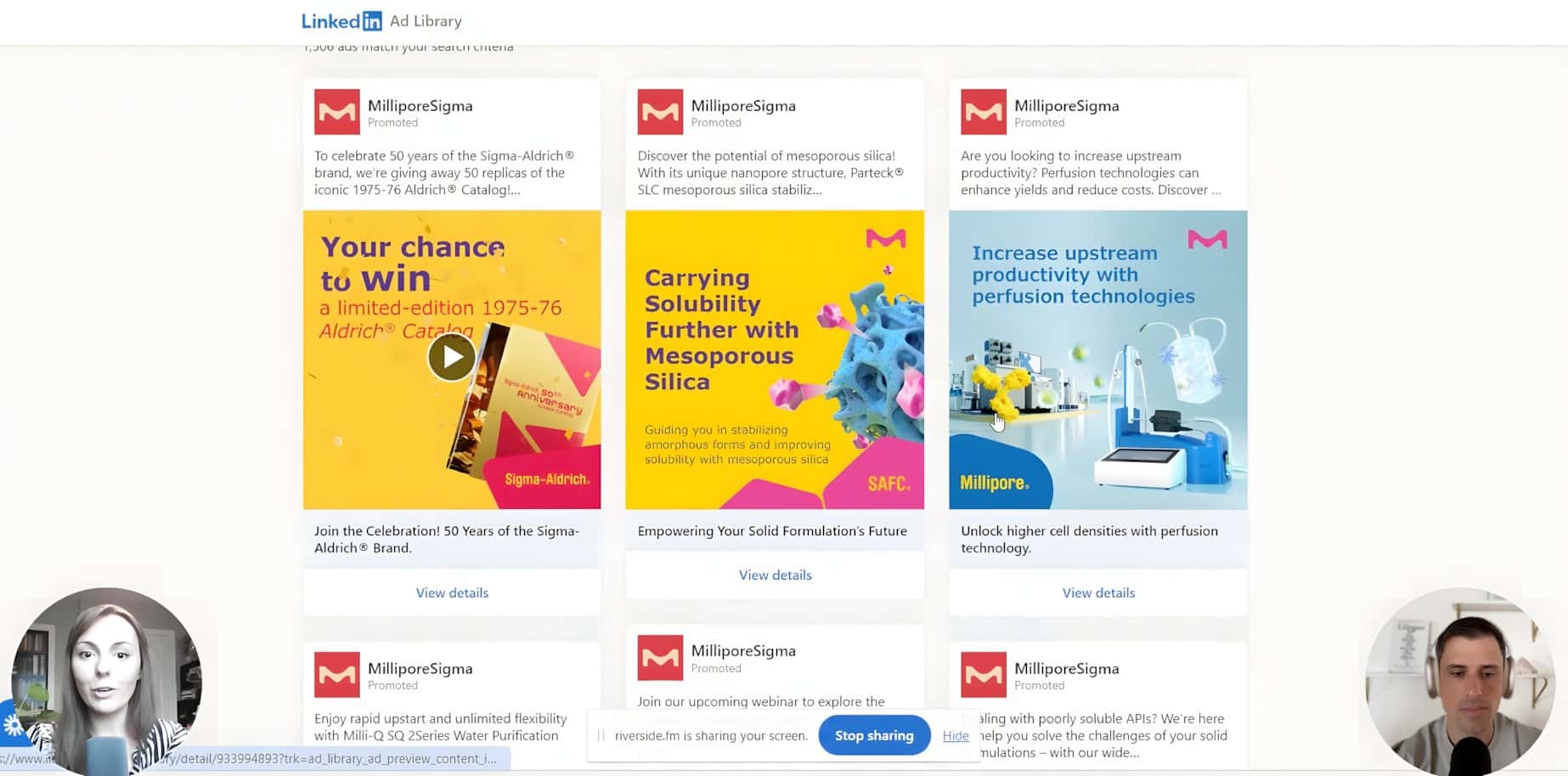
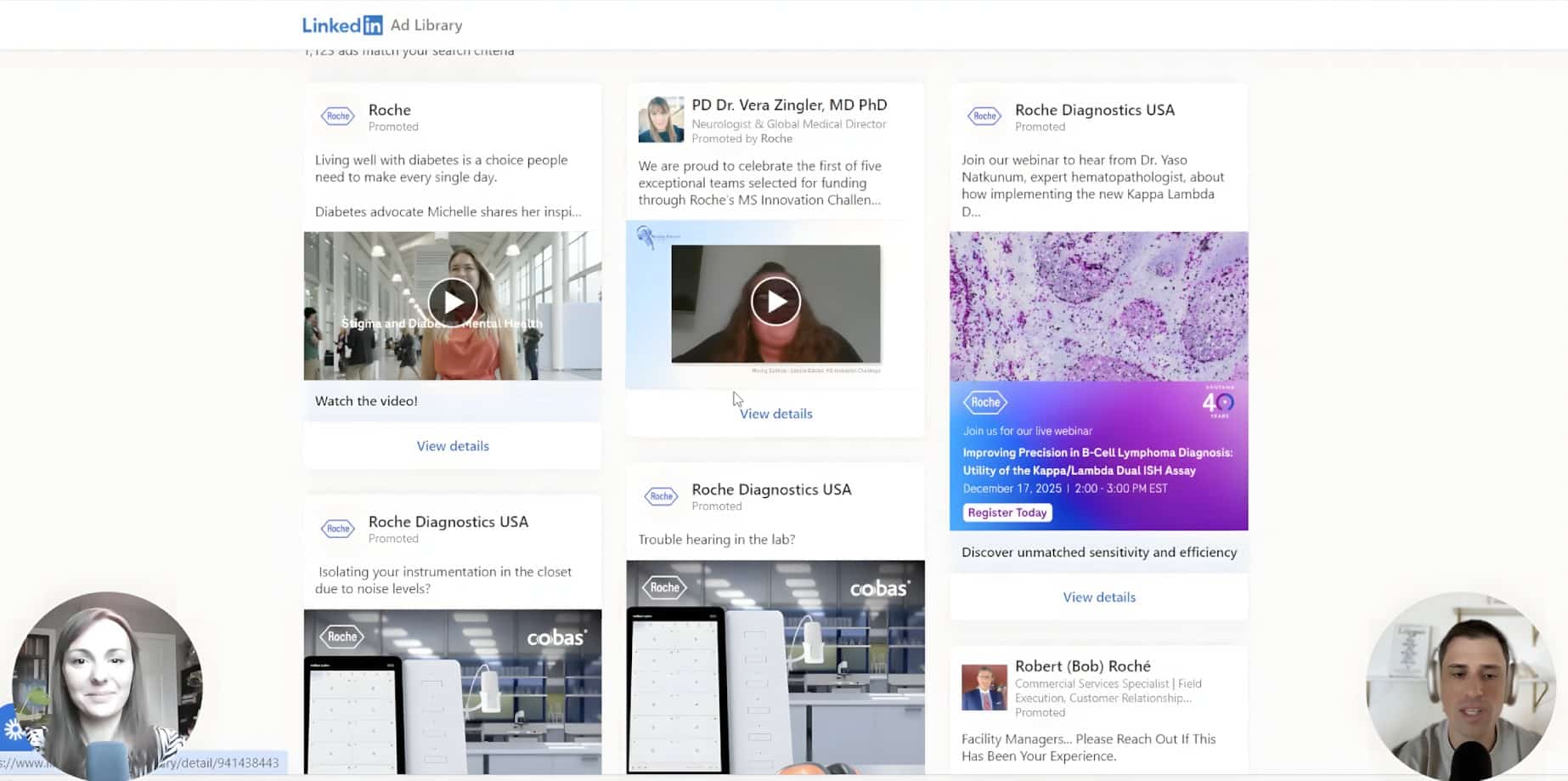
To help make the conversation concrete, we pulled up real campaigns from two of the biggest names in the industry, MilliporeSigma and Roche, using the publicly available LinkedIn Ad Library. This tool allows you to search and view all the ads currently active on LinkedIn.
What did we find? Two companies with excellent content, strong creative, and compelling offers, all undermined by funnel missteps and platform mismatches that are likely to be inflating their cost per lead. The good news is that the fixes are straightforward, and most life science companies already have everything they need to implement them.
You can watch the episode in full above, or read the blog post below for a summary of our conversation.
Before we get started, a quick disclaimer: all information in this episode is publicly sourced, opinions are our own, and the Supreme Optimization team has no current affiliation with either MilliporeSigma or Roche.
Why LinkedIn Still Deserves Spend in Life Science Marketing
LinkedIn is expensive relative to most other advertising platforms, and life science marketing teams regularly raise that objection. However, the cost reflects something no other platform can offer: the ability to reach exactly the right scientists with a level of precision and scale that is hard to find elsewhere.
"LinkedIn has a lot of control over building your audience and you have a lot of visibility to who you're targeting, which is really rare," Irene explained.
The reason for this specificity and control comes down to how people use the platform. Professionals build detailed profiles because those profiles function as digital resumes, listing real credentials, real skills, and real employment history.
As Irene put it, they "want to tell you their real name, all of their credentials, everything they've done because they know it increases their chance of getting a job potentially in the future."
For life science marketers, the practical implication is significant. For example, you can target a molecular biologist working in neuroscience with experience in a specific technique, or seek out senior researchers at diagnostic companies listing multiplexing as a skill. No other advertising platform with such a large reach lets you build audiences with that level of scientific specificity.
Beyond targeting precision, LinkedIn offers other advantages that are easy to overlook.
To start with, the platform has far fewer bots and fake profiles than Meta or X, which means your impressions are reaching real people. Brand safety is also built into the platform's professional environment, so your ad won't appear next to inappropriate content. Lastly, the quality of leads is higher because the interaction model is consent-based: prospects engage with your content, see value in it, and voluntarily share their information.
"You start a conversation properly," as Irene described it. "You want this interaction to be respectful, professional, and more importantly, you're providing them something really valuable."
I've seen this play out firsthand and have shifted 75% of Supreme Group's advertising budget from Google to LinkedIn because the conversations that come from LinkedIn leads are consistently stronger. People engage when they see what we do, and LinkedIn is a key place where many of those conversations start.
Translate intricate data into powerful, accessible messages;
Manage reputational risks with precision;
Help life science companies build lasting credibility with the audiences that matter most.
Where the Funnel Leaks
If LinkedIn offers all of these advantages, why are so many life science companies probably getting fewer leads and paying more per lead than they should?
To find out, Irene and I went into the LinkedIn Ad Library and pulled up live campaigns from MilliporeSigma. The first thing we noticed was that the creative is genuinely strong. The ads use bold colors, including striking new yellows and pinks, that stand out against LinkedIn's default blue and white feed.
This is important. "A lot of people select white and blue," Irene noted. "And that's unfortunately the colors that are predominant on the LinkedIn feed. And so when you're a person that's just scrolling through, if the ad is like white and blue, you're not going to see it."
MilliporeSigma avoids that trap entirely. The headlines are solid. The imagery is clean and professional. On the surface, these are well-executed ads.
But the problems start the moment someone clicks.
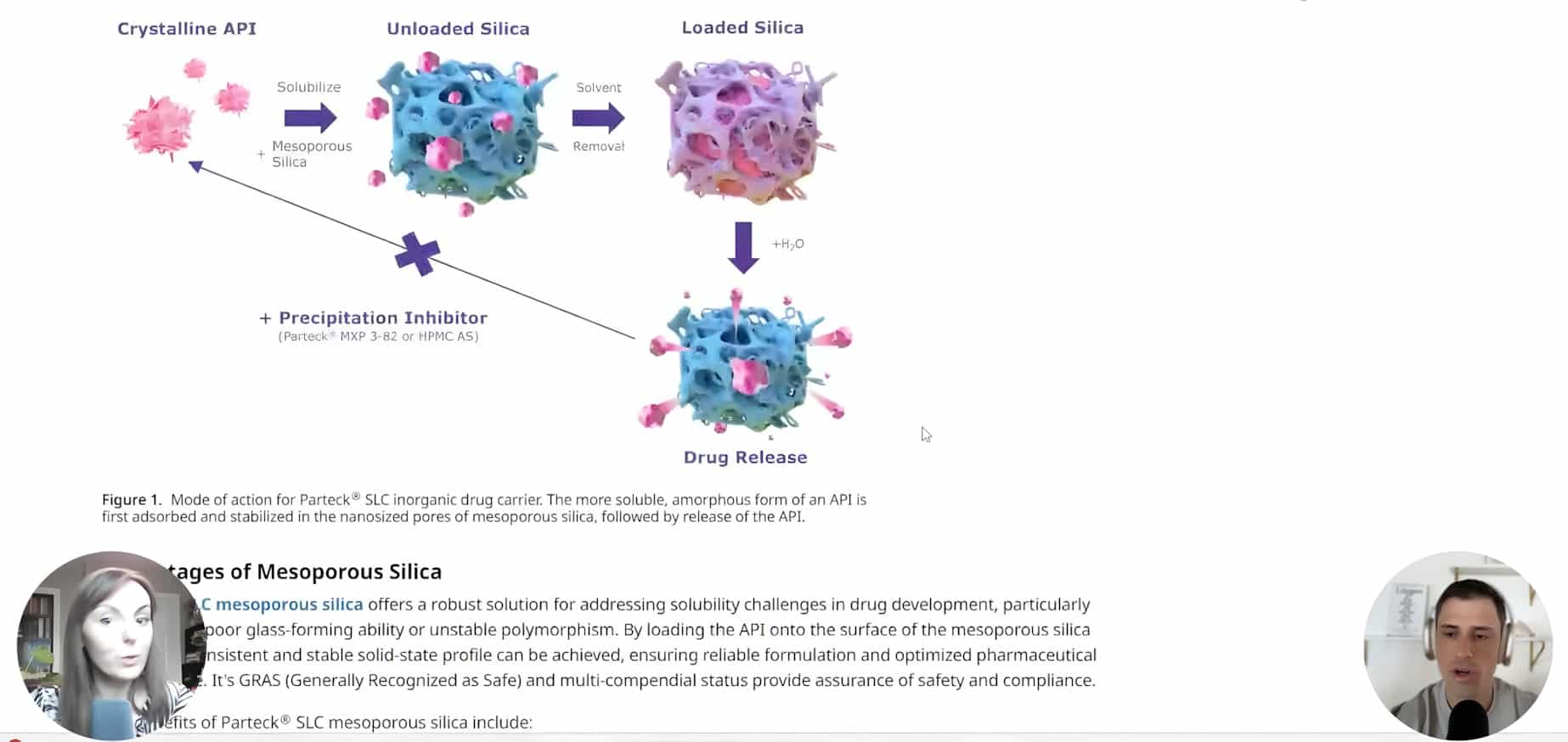
One ad promotes a mesoporous silica product with a "Learn More" call to action. A reasonable person would expect to land on an educational page, maybe a blog post or a detailed product overview. Instead, the click leads to a landing page where the primary action is requesting a free sample. On the face of it, this is an excellent offer, but showing it to someone who clicked "Learn More" creates a mismatch. The prospect expected information and got a “conversion ask” they weren't ready for.
The friction compounds from there. Requesting the sample requires navigating a second landing page with an extensive form that includes product selectors and multiple fields. On mobile, where most LinkedIn users tend to interact with ads, the experience is especially difficult to navigate. "You paid for the click, but … you missed an opportunity to teach them more," Irene summarized.
The problem is not a lack of content. When we explored MilliporeSigma’s landing pages further, we found rich infographics, detailed product information, and a beautiful product video that would perform exceptionally well as a LinkedIn ad.
All of the ingredients for a high-performing campaign are there.
The problem is sequencing: the wrong content is paired with the wrong CTA at the wrong stage of the buyer's journey, and every unnecessary click is a point where prospects drop off and cost per lead increases.
Building a Three-Stage Funnel from Content You Already Have
So what would we do differently?
Irene and I reconstructed MilliporeSigma's campaign using the exact same content assets. No new creative, no new landing pages, just a different sequence.
The structure is a straightforward three-stage funnel. At the top, we would run awareness content. For MilliporeSigma, the product video we found on their landing page would be ideal. It's visually compelling, scientifically substantive, and short enough to hold attention on a mobile feed. Anyone who watches a meaningful portion of the video, say 25% or more, would get added to a retargeting audience.
In the middle of the funnel, we would take the infographics and detailed product information from the landing page and package them as a downloadable PDF, an e-guide, or a technical brief. We would then show this asset to the retargeting audience using a LinkedIn lead gen form. These prospects have already engaged with the video, so they have context on the product and are more likely to exchange their contact information for a deeper resource.
At the bottom, we would show the free sample offer exclusively to people who've already submitted a lead form and downloaded the PDF. They understand the product, have self-selected by engaging with your content twice, and are far more likely to complete a sample request.
What’s more, instead of sending them to a complex external landing page, we would collect their information through a simple LinkedIn lead gen form: first name, last name, email, and a brief note about their needs. A salesperson should then follow up to sort out the specifics.
As Irene said: "All the pieces are here. We just need to put them in the right order."
Each stage filters the audience so you're only paying for conversion-focused ads targeting people who've already demonstrated interest. The lead gen form eliminates the friction of external landing pages and keeps users on LinkedIn, which the platform's algorithm rewards with better delivery. And the free sample offer, which is genuinely compelling, reaches prospects at the moment they're most ready to act on it.
Finding the Right Scientists: The Audience Layering Approach
A well-structured funnel only delivers results if the right people enter it.
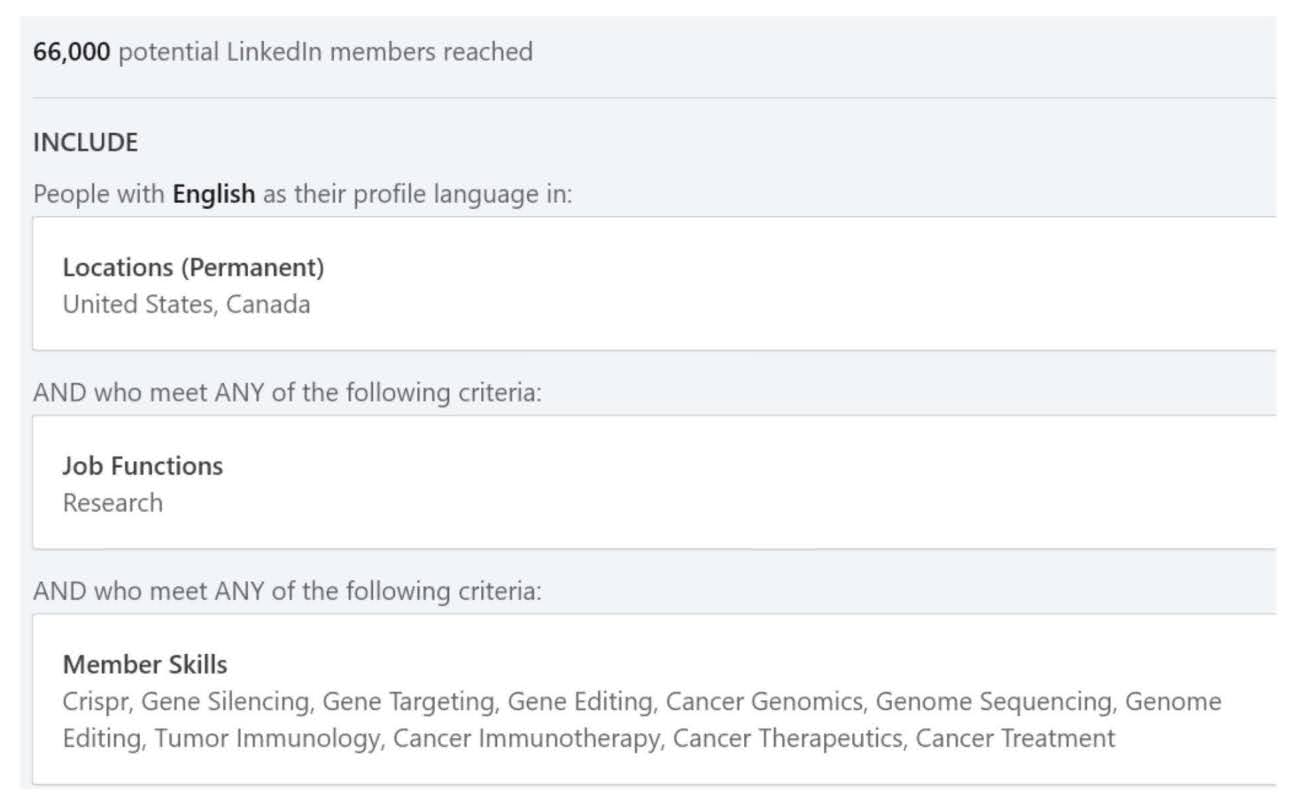
Irene's approach to audience building on LinkedIn uses what she calls layering. "LinkedIn audiences are like dressing up for winter, you gotta layer up," she said.
The process starts broad and narrows systematically.
The first layer is geographic. "The minute you include India, it's gonna take up all of your spend," Irene cautioned. "India's cheaper [to reach on LinkedIn]. So for your budget, that's always going to be a problem." If you need to reach multiple regions, set up separate campaigns so budgets don't skew toward the cheapest clicks.
The second layer is industry. Rather than relying solely on a list of target companies, Irene recommends cross-referencing those companies against LinkedIn's industry categories: biotechnology, chemical manufacturing, diagnostics, and others. Adding industry targeting alongside your company list expands the audience to include companies you may not have been aware of without losing relevance.
The third layer is job function and seniority. Selecting a job function like "research" and then layering in seniority levels such as manager, director, and C-suite dramatically narrows the audience.
Equally important as part of this process is the use of exclusions. "It's not just including research, it's also excluding accounting and administration and marketing and sales," Irene explained. For expensive equipment or services, a bench technician is unlikely to be the decision-maker, so seniority filtering ensures you're spending on the people who can actually authorize a purchase.
The final layer, and the one Irene considers the most powerful, is member skills. Scientific member skills on LinkedIn are remarkably specific. If you're promoting a piece of multiplexing equipment, you can target professionals who list multiplexing as a skill. "They will understand how valuable something like this could be to their workflow," Irene explained. Member skills transform a reasonable audience into a precise one, and building an audience in this way is unique to LinkedIn, which is what gives the platform so much power.
The cumulative effect of this layering strategy is significant. You start with a broad pool and arrive at senior research professionals in relevant industries with specific scientific expertise, in the geography you can actually serve. Every layer reduces waste and drives down cost per click, which flows directly into a lower cost per lead when combined with a properly structured funnel.
Thought Leadership Ads: A High-Performing Format for the Top of Your Funnel
Moving our analysis to Roche, one ad format stood out during our review of the company’s LinkedIn ad campaigns: thought leadership ads.
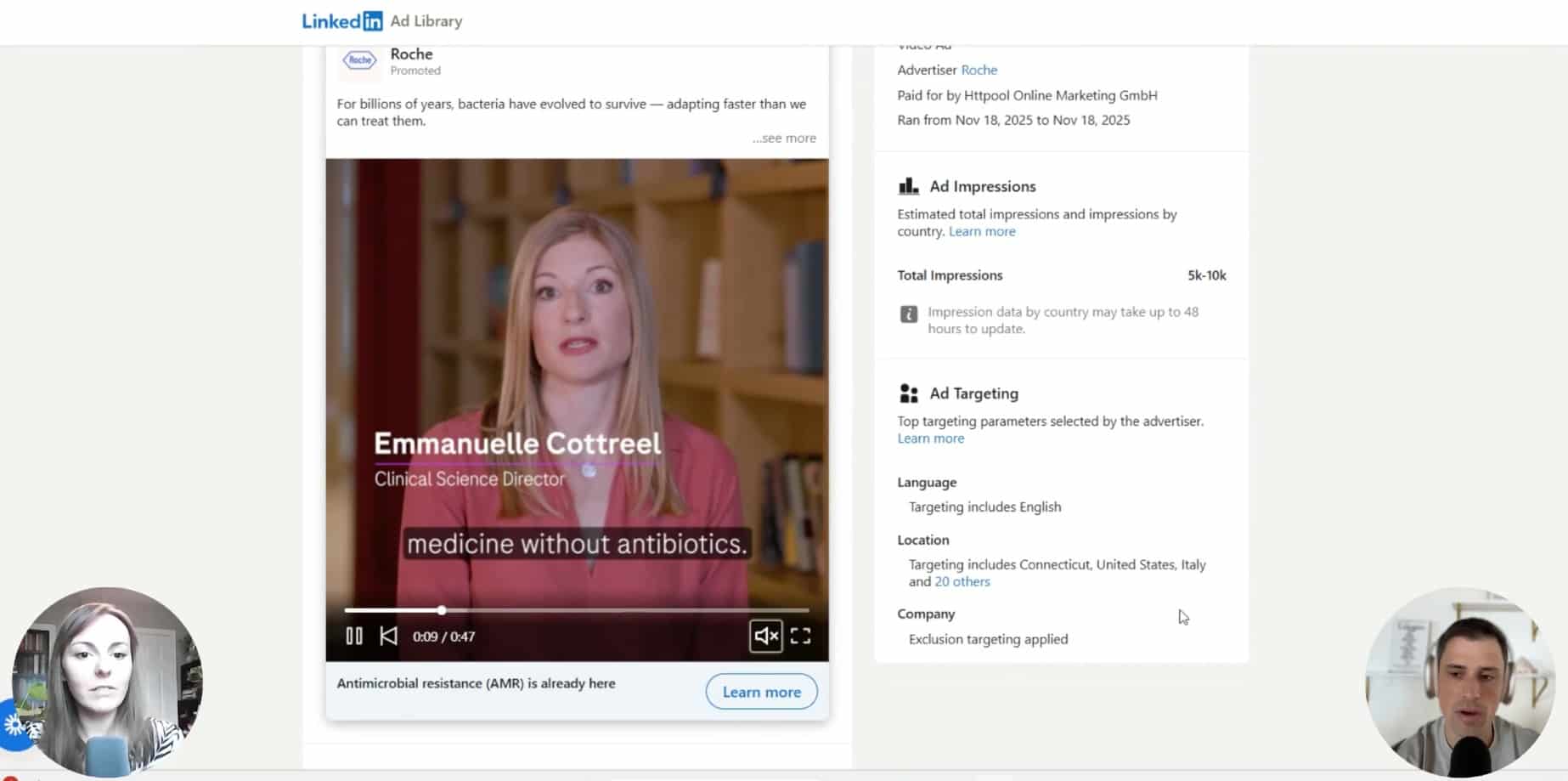
Thought leadership ads allow a company to promote a post from an individual employee's LinkedIn profile rather than the company page. The result looks and feels like organic content from a real person, with the "Promoted by Company" label appearing in small text that's easy to miss. In fact, in our experience, thought leadership ads on LinkedIn deliver 10x the click-through rate as other ad types, and I suspect this tiny “promoted” label is a key reason why.
Roche is using the format well. They feature real scientists and clinicians from within their organization, people with titles like "Head of Infectious Disease Discovery," speaking authentically about their work. The videos feel genuine rather than produced, which builds trust with a scientific audience that is naturally skeptical of polished corporate messaging.
Where thought leadership ads fit into the funnel is at the very top. A short, authentic video from a credible scientist generates awareness and watch time that feeds your retargeting audiences for mid-funnel lead generation. The format's higher engagement rate means you're building those retargeting pools faster and at a lower cost per impression.
Getting scientists to participate is often the hardest part, though. Irene shared an example of a client whose scientist produced a winning video that ran for an entire year: "She was so great. She had the right energy. She was so eloquent. [But] she does not want to be a thought leader. She just wants to be a scientist."
And that’s the rub. In general, the best candidates for thought leadership often don’t want to be thought leaders, so convincing them to lend their credibility to marketing efforts requires patience and relationship-building. Fortunately, the performance gains will make it worth the effort.
Optimization Is a Weekly Habit, Not a Launch-Day Task
Even a well-built funnel with precise targeting and strong ad formats requires consistent attention. "You have to be in that account every week because things stop working," Irene said. "There's winning ads and losing [ads]. You can't just set it and forget it."
Her recommended optimization rhythm for lead generation campaigns focuses on two areas.
First is testing your ad creative. After launching a campaign with multiple ad variations, give them about two weeks to accumulate data, then pause everything that isn't generating leads. Take the winning ad and create a variation with a different headline or a different visual but a similar structure, and test again. "Within like three months, you really narrow in on the imagery and the headline and the CTA and everything that the audience most wants to convert on," Irene explained.
Second is reviewing the quality of your leads. Generating a high volume of leads means nothing if those leads aren't the right people. "We constantly bug our clients," Irene described. "Okay, did you like this lead? Okay, it's not the right job title. Okay, we're gonna exclude it. Did you like this company? Oh, it's a competitor, but you didn't realize they were a competitor? Okay, let's exclude it."
Each exclusion cleans up the audience, reduces wasted spend, and improves the conversion rate of the remaining pool. Over time, the cost per lead drops as the campaign's targeting and creative converge on what actually works for your specific product and audience.
Optimizing Your Campaigns: You Already Have the Pieces
The pattern Irene and I saw across both MilliporeSigma and Roche was consistent: strong content, talented creative teams, and compelling offers, all likely undermined by funnel mismatches and platform-specific execution gaps.
"Those landing pages are [probably] optimized for other platforms," Irene observed. "They're probably more optimized for Google Ads, maybe it's programmatic. I just think that they weren't thinking about LinkedIn or how to use those pieces on LinkedIn."
When I asked Irene what she'd change with a magic wand, her answer was simple: "I'm almost guaranteeing that you probably already have at least three pieces of content that are already perfect for LinkedIn. You don't need to overthink it."
Restructuring the funnel, layering the audience, using thought leadership ads, optimizing weekly: none of these fixes require starting from scratch. They require looking at what you already have and sequencing it for the platform where your ideal customers are actively building their professional identities and engaging with scientific content.
If your LinkedIn ads are generating leads but the cost per lead feels too high, the answer is probably not more budget or new lead-gen content. It's a better funnel. If you'd like help building one, our paid advertising team works with life science companies on exactly this.
Want to learn more? Listen to the full episode with Eric Southwell and Irene Lecker on Spotify, Apple Podcasts, YouTube, or wherever you get your podcasts.