The rules of life science marketing are shifting. Strategies that delivered results as little as two years ago are losing their edge, while overlooked channels and formats are emerging as surprising sources of competitive advantage. All of this takes place in a backdrop of rapid technological change driven by AI. For senior marketers trying to allocate budgets and prioritize campaign initiatives, the question is: where should you place your bets in this new reality?
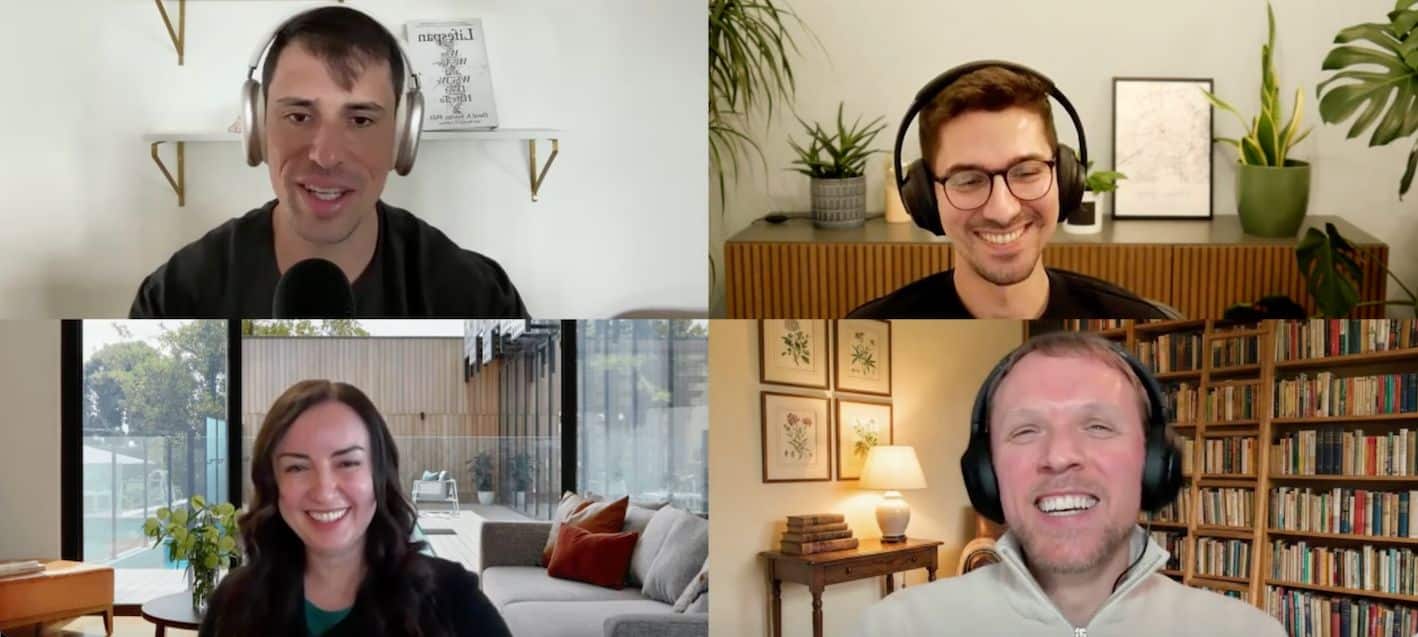
To explore what lies ahead, I sat down with three life science marketing veterans for a special roundtable episode of The Supreme Pod. Joining me were Mihaela Pupavac, who leads the paid advertising team at Supreme Optimization and holds a PhD in human genetics from McGill University; Paul Avery, VP of Marketing at Supreme Group and former co-founder of BioStrata, with a PhD in molecular biology from the University of Cambridge and over 15 years of integrated marketing experience across life science and healthcare verticals; and Joachim Eeckhout, founder of Labiotech.eu and The Science Marketer, now leading the newly formed Knowbio. Between the four of us, we have decades of experience in the trenches of life science marketing, and we pooled our observations into five key topic areas and predictions for 2026.
What emerged from our conversation was a common thread… in an era of AI-generated content and channel noise, the marketers who win will be those who choose their channels wisely, while also doubling down on authenticity, expertise, and human connection. You can watch the episode in full above, or read the blog post below for a summary of our conversation.
Why Bing Ads Are a Hidden Opportunity for Life Science Marketers
I kicked off our discussion by highlighting a contrarian take for 2026: why every life science company should start running Bing ads.
If you have a limited budget for paid search, putting it all on Bing might sound counterintuitive. But the data tells a compelling story.
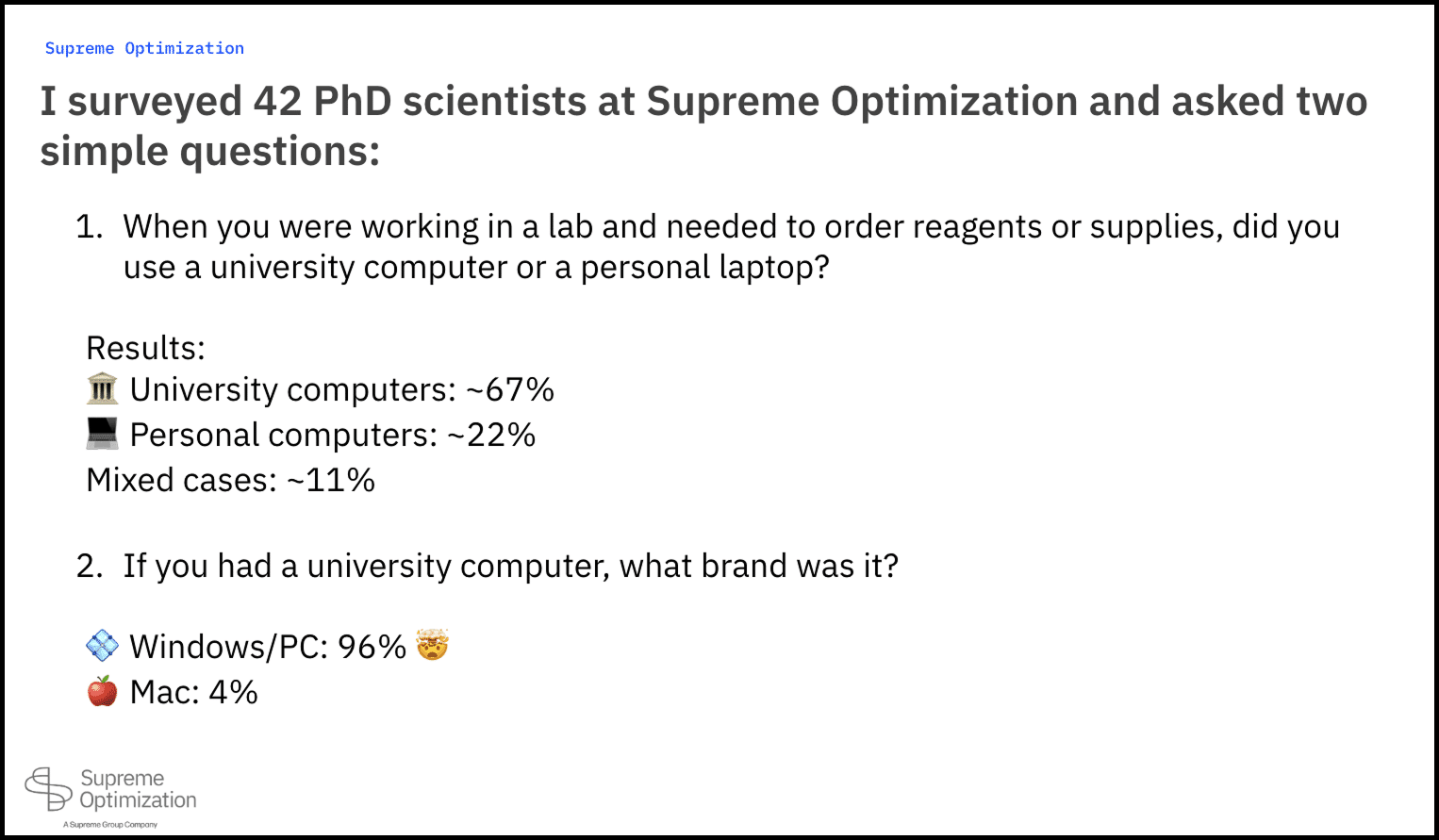
Firstly, most scientists work on university-issued PCs, not personal laptops. In many cases, they cannot download external browsers or change default settings, which means they search using Microsoft Edge and, by extension, Bing. A quick survey of the PhD team at Supreme Optimization confirmed the pattern: nearly everyone used a PC in the lab, and almost none used Macs.
Translate intricate data into powerful, accessible messages;
Manage reputational risks with precision;
Help life science companies build lasting credibility with the audiences that matter most.
Results from my internal survey on lab computers used by PhDs at Supreme Optimization. Overwhelmingly, people used university-owned PCs, and that means Bing.
The implications for paid search are significant. If you are only running Google Ads, you are likely missing a substantial portion of purchase-ready scientists who are searching on Bing by default. And the economics are favorable: Bing clicks tend to run about 50% cheaper than Google, with less spam leads and often higher lead quality overall.
Mihaela has seen the trend firsthand. "People are really sleeping on Microsoft and Bing ads," she said. "For the clients that [were] running Bing in 2025, Bing has performed better than it ever has in the past. We've definitely seen lower cost per lead than we ever have, and we've seen a higher volume of leads than we ever have."
The caveat is that Bing's algorithm is not as sophisticated as Google's, which means keyword selection and campaign setup require more precision. "If you're launching that campaign starting in Microsoft, it's even more critical that the keywords that you're selecting are really good, tight, long-tail, high-intent, bottom of the funnel type keywords," Mihaela explained, "because the algorithm isn't as good at getting you users who are more likely to convert."
For marketers already running Google Ads, the good news is that campaigns can be ported into Microsoft Ads relatively easily. The platform is designed to mirror Google's structure. But porting is not a set-and-forget exercise; ongoing optimization remains essential, particularly given Bing's less mature algorithm.
There is also a speculative upside worth noting. With OpenAI and Microsoft's close partnership, there are rumors of future integration between Microsoft Advertising and ChatGPT. For marketers wondering how to prepare for ads in AI interfaces, establishing a presence on Bing now could prove to be a smart hedge.
The Key to Effective Thought Leadership in 2026
Next, we moved onto the nuanced world of thought leadership within life science marketing, an industry where the term means different things to different people. Some think of white papers and research reports produced by a company, while others think of LinkedIn posts published by individuals as brand ambassadors. The distinction matters because the approach required for each tactic and channel is fundamentally different.
Joachim, who has built a significant audience through The Science Marketer newsletter, emphasized that, regardless of your approach to thought leadership, consistency is the foundation. "If you're not consistent in your publishing, then it goes nowhere," he said. "You cannot create an audience. And it's something I repeat almost in every post I write, because people underestimate how hard it is to keep consistent with content."
His advice is to be realistic about resources from the start. If you can only commit to one article per month or one LinkedIn post per week, that’s fine, as long as you stick to it over the long haul.
Working with an external partner, whether an agency or a freelancer, can also help you to maintain cadence when internal bandwidth is limited. For example, for executives who lack the time to write, a one-hour interview every two weeks with an external content marketing expert can yield enough raw material for weeks of content. The conversation captures the executive's authentic voice and insights, and a skilled writer can then shape it into posts, articles, and other assets. The executive invests minimal time while the output remains genuinely theirs.
However, consistency is not the only challenge. The content itself must offer genuine insight. Paul put it succinctly: "Thought leadership is not saying something; it's having something to say." This distinction is critical in an era when AI can generate passable prose in seconds (even if a lot of AI-generated content lacks expert insight, especially in niche industries).
With this in mind, Joachim noted that the best-performing content on platforms like Substack tends to be highly specific and expert-driven, offering perspectives that readers cannot find elsewhere. "At the end of the day, the really good content we have now today comes from humans and their own experience," he said. "You can ask the AI to write a post, yes, it will do it. But the really good content comes from humans."
Consistently creating insightful content is hard enough, but ensuring it actually reaches your audience can be even harder. With this in mind, the panel discussed the importance of amplifying reach with paid promotion. For example, LinkedIn's thought leadership ads allow you to boost posts from personal profiles, not just company pages. This approach is especially powerful for targeting life science audiences, as scientists often upload technical skills to their LinkedIn profiles, which means you can target audiences based on competencies like DNA extraction, CRISPR, or PCR.
The economics of LinkedIn Thought Leadership ads are also favorable right now. Joachim noted that his team has seen strong returns with modest investment. "Sometimes we just put 50, 60 euros behind the post and it doubles the exposure, which was already high. It's a very good tactic," he said. When it comes to using this paid platform, we find that the best approach is to let content prove itself organically first; when a post resonates, that signal tells you it is worth amplifying to a larger audience.
The Ongoing Growth of Life Science Podcasting
Podcasting is underestimated in the life sciences, largely because it is difficult to tie directly to commercial ROI. But the intangible benefits have an impact that is hard to replicate using other marketing approaches, particularly when it comes to shortening the sales cycle.
Paul shared a story that illustrates the point. During a sales call, a prospect was speaking to him as if they already knew each other well. Halfway through the conversation, slightly embarrassed, Paul asked if they had met before. The prospect explained that they had recently transitioned into life science marketing from another sector and had listened to Paul's podcast to get up to speed. The effect is what researchers call a parasocial relationship: listeners feel like they know the hosts, even though the relationship is one-directional.
The commercial implication is significant. "It gives you that pre-trust," Paul explained. "It collapses that distance between me as a stranger and me as a credible person that can actually help them." In effect, the first sales call feels like the second. The relationship-building that normally happens over multiple interactions has already occurred invisibly through the podcast.
Paul shared a second example: someone he didn’t know tagged him on LinkedIn, promoting the podcast unprompted. When Paul reached out to thank them, he learned that the person's company uses the podcast as onboarding material for new sales and marketing hires. "You cannot buy that type of interaction," Paul said. "You cannot get that type of buy-in by purchasing it. You have to produce something that you believe is going to be valuable … and then give it to people."
Joachim confirmed the same experience with The Science Marketer podcast. "I have people sometimes I don’t know [and] I go on a call and they already know me, exactly the same," he said. He also noted that a major European VC firm shares his podcast with every startup founder they finance as part of their marketing education.
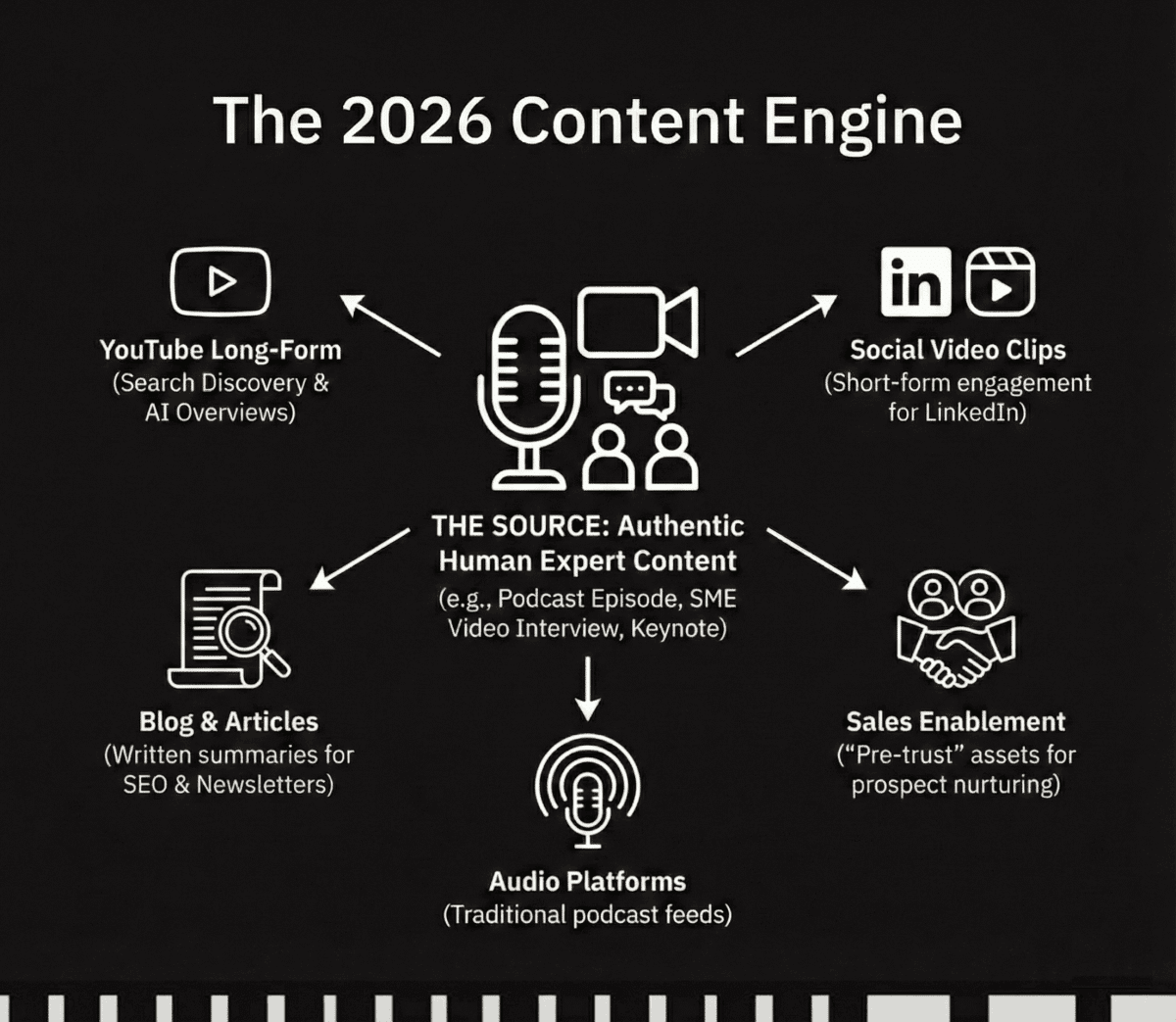
Beyond this type of “pre-trust” relationship-building, podcasts can also serve as content production engines. A single episode can yield short-form video clips for LinkedIn, as well as content for YouTube, blog posts, and social media snippets. In some cases, the podcast itself may not drive significant listenership, especially if you work in a very niche sector, but the derivative content can reach a much wider audience across multiple channels.
How podcasts and other authentic human expert content can form the basis of a content engine driving distribution and reach across multiple channels.
During our discussion, we highlighted how YouTube deserves particular attention. Joachim noted that his podcast gains more traction on YouTube than on traditional podcast platforms because YouTube's algorithm is better at recommending content to new audiences. For niche life science topics, there is also often little competition for long-tail searches on YouTube, which means even modest content can rank well.
Even given all of the above, the challenge remains: how do you measure and demonstrate value to stakeholders when traditional attribution models fail to capture the influence? Mihaela noted that this is a common issue with upper-funnel activities. "You don't necessarily see … in your CRM that a lead came from that," she said, "but it's so critical. I can't say the number of times when I talk to clients, they'll mention a post that we made, they'll mention an email. But these things, you're not going to find them in your CRM."
The practical workaround is to build measurement into the process more directly. For example, adding a "how did you hear about us" dropdown to contact forms, running periodic surveys, or simply asking prospects during sales calls. The attribution will never be perfect, but directional signals are often enough to justify continued investment.
Given the trust-building potential and content leverage that podcasts provide, we expect more life science companies to invest in the format in 2026, whether by launching their own shows or working harder to secure interview slots for their subject matter experts on established podcasts.
How to Leverage AI in 2026
These days, every marketing conversation eventually turns to AI, and our panel conversation was no different. Our take: the temptation in the market at the moment is to either dismiss it entirely or treat it as a silver bullet. The reality, as we discussed, is more nuanced.
To start with, while AI is certainly making marketers faster, it is not replacing the need for expertise. As an example, Mihaela noted that platforms like Facebook have promised full automation, but the reality has not matched the hype. "AI is just making us faster," she said. "There's a lot of AI within platforms, a lot of automations. You can make automated videos and images and write ad copy faster. But if you're just using the platforms to do it, it's going to have that AI feel. You can run into issues of AI slop."
Paul agreed with Mihalea: "I wrote a post on LinkedIn about how AI can write beautiful-sounding sentences that mean nothing," he said. "If you really read some of the stuff that comes out, especially long -orm, it will make statements that are so plausible-sounding, and then you really think about what it's saying, and you're like, that's wrong, or that doesn't make sense."
The risks of publishing inaccurate content is amplified in life sciences, where the target audience has been trained to critically assess everything they read. "Is there a more dangerous industry to entrust your content marketing program to ChatGPT?" Paul asked. "I doubt it." Credibility trumps efficiency at this point in time, although the balance could tip with every new AI model that's released.
The takeaway here is not to avoid AI but to use it with clear-eyed awareness of its limitations. AI accelerates expert work; it does not create expertise.
The Battle for Bottom of Funnel Changes Shape
For a decade, the inbound marketing playbook was clear: create educational, "top of the funnel" content, rank for long-tail keywords, capture traffic, nurture leads, and convert them over time. And if you wanted to speed up traffic and lead generation, you could always turn to advertising options, such as paid search and paid social.
Even though the adoption of inbound marketing was slow in the life science sector, it did catch on eventually and produced significant results for the companies that invested in it.
However, what happens when AI starts answering those educational and informational queries directly, and searchers never click through to your website?
"You're not going to get found so easily in search anymore for educational queries," Paul said. "You're not going to get that website traffic. How are we going to deal with this?"
The data suggests the shift is real but still early. Within Supreme Group's own marketing efforts, AI search now accounts for roughly 10-12% of leads, up from almost zero a year ago. Looking at referral traffic, we can see that tools like ChatGPT and Perplexity are becoming meaningful traffic sources.
But Mihaela cautioned against overgeneralizing. "Typically when we look at [Google Analytics 4] data for clients, SEO and paid search are still the biggest drivers of traffic and performance," she said. "The traffic coming from ChatGPT and other AI searches tends to be much, much smaller, very low or even below 1%."
Diving deeper into the data, Mihaela found an interesting correlation between strong SEO and AI search visibility. Clients with a long history of SEO investment tend to see higher percentages of traffic from AI search, while those with weak websites see almost none. The implication is that the fundamentals of SEO, including high-quality content, clear messaging, reputable backlinks, and strong technical performance, also matter for AI visibility.
Joachim agreed. "The whole of GEO is a scam," he said, drawing laughs from the panel. His argument was that companies with solid SEO practices will naturally appear in AI-generated results without needing a separate strategy. "If you have been doing SEO and you have been spending time on trying to rank for your long-tail keywords, you will certainly end up in the response of the LLMs when someone asks about the same topic."
GEO is a scam! From top right, clockwise: Joachim, Paul, Mihaela, and I sharing a laugh on our LinkedIn Live
From my perspective, one genuinely new dynamic worth watching is YouTube's role. AI overviews on Google increasingly pull from YouTube as a source, likely because video content is harder to fake and carries stronger signals of authenticity. Investing in video content that ranks on YouTube is no longer just a brand building or content marketing exercise; it is becoming an even more important component of search strategy.
On the paid search side, Mihaela reinforced that performance has not declined despite the rise of AI overviews. "If anything, paid search performance has only increased in 2025," she said. In her view, people are using AI for early-stage research and exploration, but when they are ready to purchase, they still turn to Google and click on links to websites in order to review product information, compare pricing, and execute the purchase.
The strategic takeaway from the panel's discussion was that winning at the bottom of the funnel increasingly depends on winning at the top of the funnel i.e. being the trusted, go-to brand in your sector.
Paul put it succinctly: "You need to be the IBM of your niche industry, so that when people are going to do that search, your product and brand is the branded term that they put in there."
The blog posts, the thought leadership, the podcasts, the video content: these are not just awareness plays. They are how you ensure that when a buyer is finally ready to purchase, your brand is the one they search for by name.
Why Video is Your Cheat Code in 2026
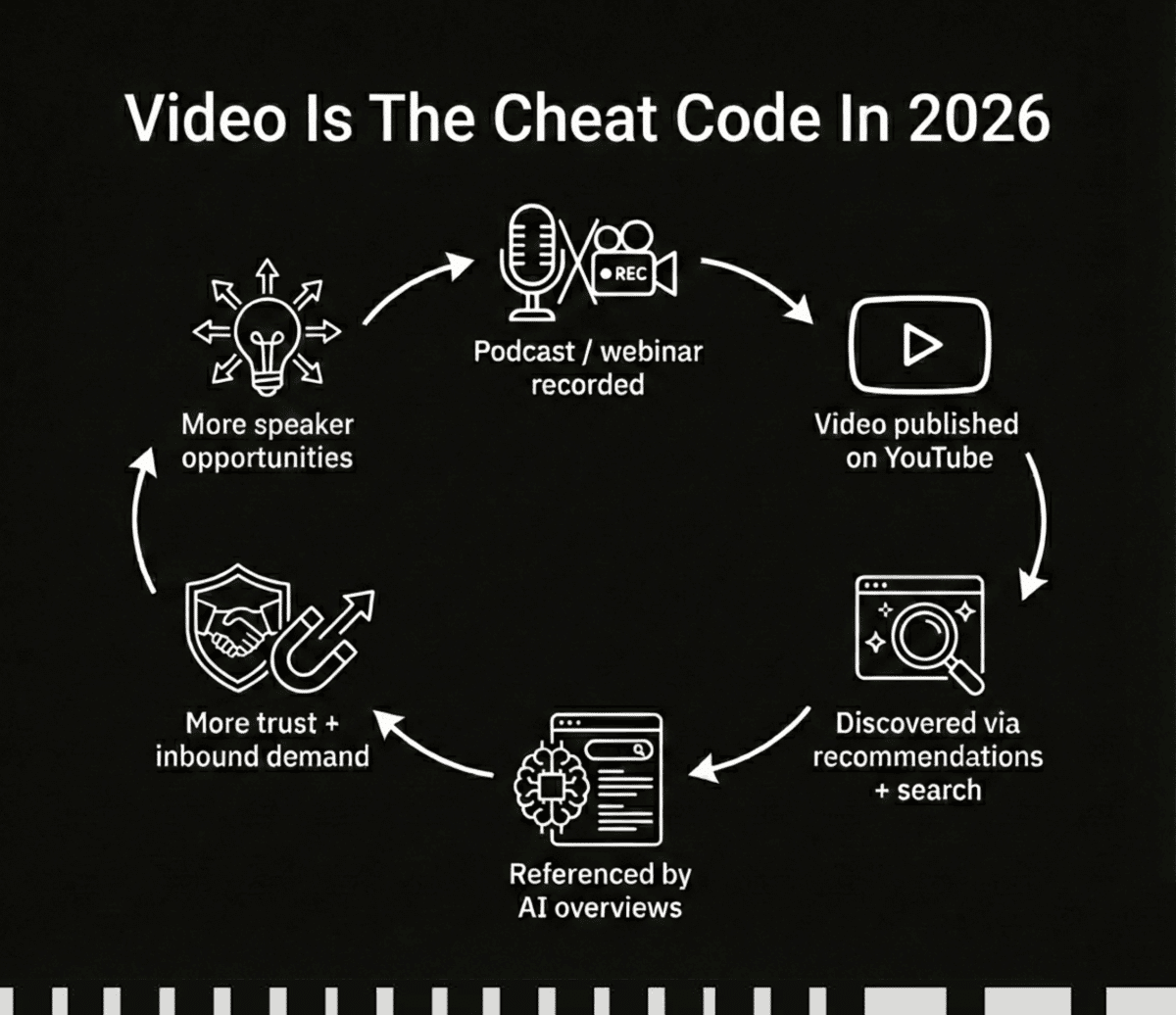
Throughout the conversation, video kept emerging as a common thread. Podcasts feed YouTube. YouTube feeds AI overviews. Video ads outperform static formats on paid platforms when it comes to engagement. And in a world of AI-generated text, video remains the format that most people still trust as being genuinely human.
Mihaela made the case directly. "Do not sleep on video content in 2026," she said. "There's no more authentic format than video … All of the [paid ad] platforms are pushing more videos, [they are] performing better than ever."
For life science companies, video has traditionally been a challenge. Production can be expensive, internal stakeholders are often camera-shy, and the ROI is hard to measure. But the white space is also an opportunity. Few competitors are investing heavily in video, which means even modest efforts can stand out.
The practical path forward is to treat video as a feeder or byproduct of other activities, rather than a standalone production. For example, a podcast episode or webinar can yield video snippets that can be shared as reels across social media. Even a simple interview with a scientist or executive recorded on a smartphone can serve as authentic content that can often resonate more with audiences than polished corporate messaging.
How authentic human video content creates a compounding engine of discovery, trust, and inbound sales (as well as future speaking/podcast) opportunities.
Our take: the platforms are rewarding video with reach, humans trust video to provide them with genuine expertise (rather than AI slop), and marketers who lean into the format now will be better positioned as algorithms continue to favor it.
Human Experts Are Still the Critical Component
If there is a single theme connecting all of the trends and predictions we discussed, it is the premium that modern audiences are placing on human expertise and authenticity.
AI can generate 10,000 words in seconds, which means written content alone is no longer a differentiator, a signal of credibility, or evidence that someone invested energy and expertise to produce something worth reading.
However, what AI cannot replicate is genuine expertise and the hard-won insights gained from years of real-world experience.
The marketers who will win in 2026 are those who invest in channels that showcase real people with real knowledge: video, podcasting, events, and authentic thought leadership.
They will pair this with a sharp understanding of the organic and paid channels they can use to reach their audiences with precision, whether those audiences are looking for inspiration, gathering information, or ready to purchase.
Showing up consistently in these spaces and providing insights that no chatbot can replicate is what will build category ownership in 2026 and beyond.
Ready to go deeper? Listen to the full episode on Spotify, Apple Podcasts, YouTube, or wherever you get your podcasts.